Do your dentures slip when you eat or talk? You are not alone. Thankfully, there is a simple fix. Snap-on dentures clip onto small implants in your jaw. As a result, they stay firmly in place. In this guide, we explain how they work, who they suit, and how to look after them. We also show how they compare with other implant-supported teeth.
What Are Snap-On Dentures?
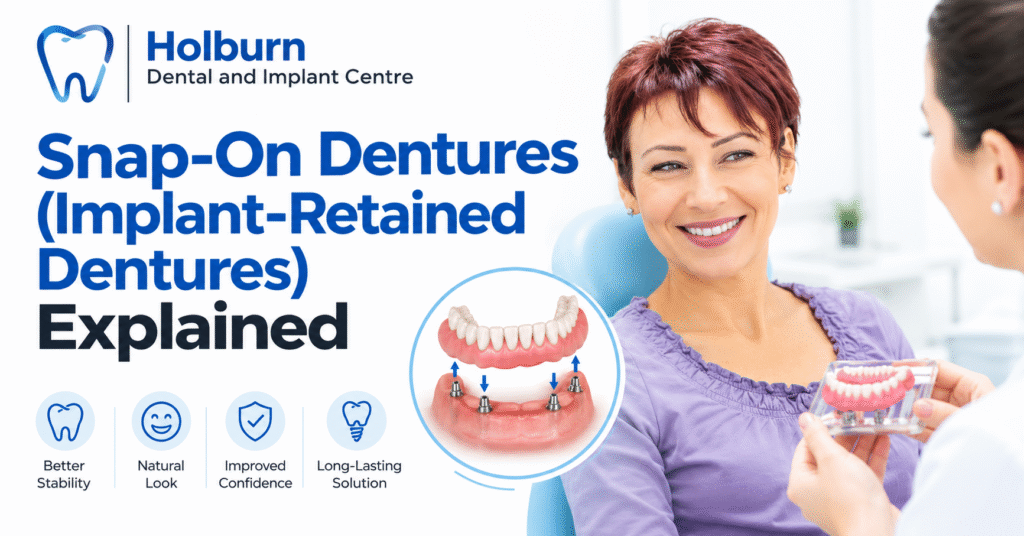
Snap-on dentures look like normal dentures. However, they work in a different way. Instead of resting on your gums, they clip onto dental implants. Dentists also call them implant-retained dentures or overdentures.
An implant is a small titanium post. Your dentist places it in your jawbone. Over a few months, the bone grows around it. Then the implant becomes a strong, steady anchor.
The denture has small clips on the underside. These clips snap onto the implants. So the denture holds tight while you eat and speak. Yet you can still take it out to clean it.
How Do They Attach?
Most snap-on dentures use one of two systems.
Ball or locator attachments. First, your dentist fits a small cap on top of each implant. Next, the denture has a matching socket. When you press the denture down, it clicks into place. Locators are the most common choice today.
Bar attachments. In this case, a thin metal bar joins two or more implants. The denture then clips onto the bar. A bar gives extra support. Therefore, it often suits the upper jaw.
In both cases, you push the denture into place with gentle pressure. To remove it, you simply lift it off with your fingers.
How Many Implants Do You Need?
The number of implants depends on your jaw and your needs.
- Lower jaw: Often, two implants are enough. Lower dentures move the most, so two implants help a lot.
- Upper jaw: Usually, you need four or more. The bone in the upper jaw is softer. As a result, it needs more support.
Before treatment, your dentist scans your jaw to check your bone. If bone is low, your dentist will talk you through the options.
Snap-On vs Fixed Implants vs Normal Dentures
| Normal dentures | Snap-on dentures | Fixed full-arch implants | |
|---|---|---|---|
| Stays in place | Can slip | Firm, clips on | Fixed, does not move |
| Can you remove it? | Yes | Yes | No, only your dentist can |
| Number of implants | None | 2–4 | 4–6 |
| Cleaning | Easy | Easy | Needs special care |
| Cost | Lowest | Middle | Highest |
| Protects jawbone | No | Yes, around implants | Yes |
In short, snap-on dentures sit in the middle. They give much more grip than normal dentures. At the same time, they cost less than fixed teeth. For a fuller comparison, read our guide on dentures versus implants.
Benefits of Snap-On Dentures
Snap-on dentures offer many real benefits. For example:
- You can eat crunchy and chewy foods again.
- Your speech stays clear because the denture does not move.
- You no longer need sticky denture glue.
- The upper denture can often cover less of the roof of your mouth. As a result, food tastes better.
- Implants help to slow bone loss in your jaw.
Most of all, many patients say they feel more confident. They can laugh and talk without worry.
How to Look After Snap-On Dentures
Here is a simple daily routine:
- Take your denture out every night. This gives your gums a rest.
- Brush the denture. Use a soft brush and mild soap. Avoid normal toothpaste because it can scratch.
- Clean the implants. Brush around each implant cap gently. Also, use a small interdental brush around the base.
- Soak the denture. Put it in water or a denture cleaner overnight.
- Visit your dentist. Regular check-ups help to spot problems early.
Over time, the small clips wear down. Fortunately, your dentist can replace them quickly. Most people need new clips every year or so.
If you have fixed teeth instead, the routine changes. Our guide on cleaning under fixed full-arch implants explains more.
Who Are Snap-On Dentures Right For?
Snap-on dentures suit many people. For instance, they work well if you:
- Already wear dentures and dislike the movement.
- Have lost all the teeth in one jaw.
- Want better grip without the cost of fixed teeth.
- Have enough jawbone to hold implants.
On the other hand, some health problems can slow healing. Heavy smoking and uncontrolled diabetes are two examples. Your dentist will check your health first. That way, they can make a safe plan for you.
Is It Time to Stop Your Dentures Slipping?
Loose dentures can make daily life hard. Snap-on dentures offer a simple and affordable fix. They give you back your grip, your comfort, and your smile.
At Holburn Dental and Implant Centre, we explain every option clearly. To learn more, explore our dental implant treatment options or book an implant consultation today.
Read Article: https://holburndentalclinic.co.uk/bad-breath-that-wont-go-away/